
Cycling
Sporting Goods
Point of Sale
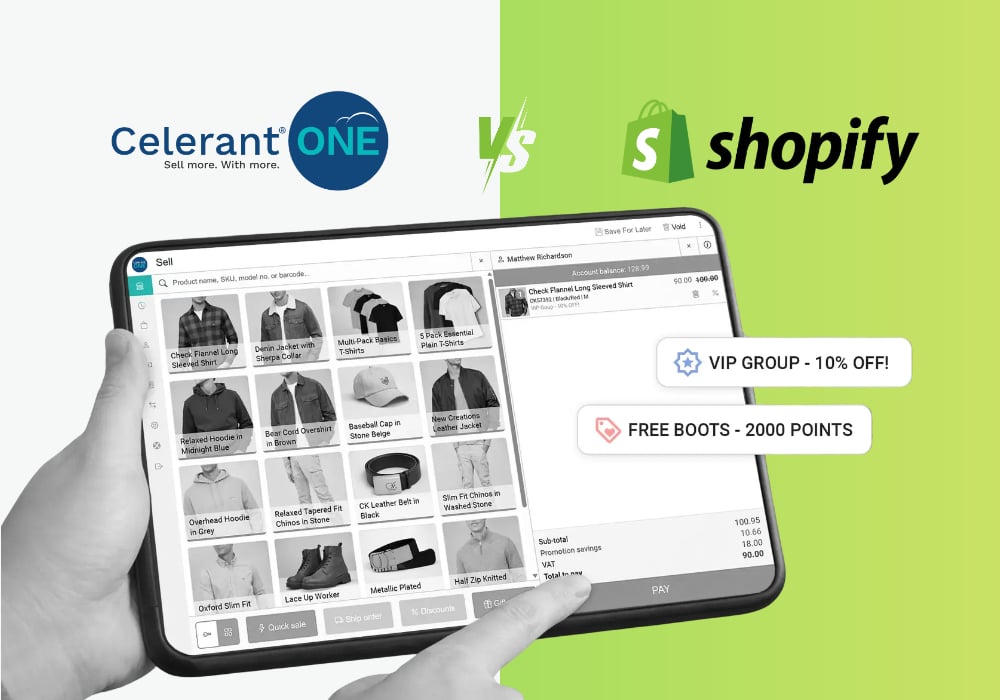

But they both have different strengths and weaknesses, along with separate pricing structures, support services, and approaches to retail management.
Shopify is a starting point for businesses looking to launch an eCommerce store and then expand it into physical retail. Saledock, recently rebranded as Celerant ONE, takes a unified approach, connecting POS, eCommerce, inventory management, and retail operations under one platform.
Which solution is better suited to your retail business? This guide compares Celerant ONE by Saledock with Shopify POS against retail features, pricing, transaction fees, customer support, and long-term value to help you make the right decision for your business.
|
Features |
Celerant ONE by Saledock |
Shopify POS |
|
In-store POS |
Yes |
Yes |
|
eCommerce integration |
Integrated eCommerce platform |
Native Shopify online store integration |
|
Multi-store management |
Yes |
Yes, with advanced features depending on the plan |
|
Inventory management |
Centralised retail inventory |
Multi-location inventory management |
|
Marketplace integration |
Optional eBay and Amazon modules |
Sales channels and third-party apps |
|
Purchase orders |
Yes |
Yes, through Shopify Admin |
|
Stock transfers |
Yes |
Yes; advanced POS workflows require POS Pro |
|
Stock takes |
Full and partial |
Stock counting available with POS Pro |
|
Accounting integration |
Xero; confirm other integrations and availability |
Xero and QuickBooks through compatible apps |
|
Payment providers |
Choice of supported providers |
Shopify Payments and supported third-party providers |
|
Additional software transaction fees |
No standard additional fee per sale |
Third-party transaction fees may apply to eligible online orders |
|
Customer support |
UK-based team, including phone and email |
24/7 chat; additional channels depend on subscription |
|
Pricing |
Fixed monthly software subscription |
Subscription plus optional paid features and apps |
Please note: Features and availability depend on subscription, configuration, and optional modules. Payment processing fees are separate from software subscription charges. Confirm published prices and features before purchasing.
Celerant ONE offers three subscription plans to accommodate different retail requirements, such as:
Depending on the selected plan, retailers can access sales management, inventory control, analytics, promotions, loyalty schemes, gift cards and eCommerce functionality.
Additional POS device licences cost £29 per month, while optional modules, including Amazon and eBay marketplace integrations, incur extra charges. Xero integration is also available as an additional monthly service, listed at £20 per month.
Published prices exclude VAT and are based on a 36-month contract. Hardware and optional integrations may increase the overall investment.
Shopify also offers multiple subscription plans, such as:
These are the annual-billing prices, and monthly billing costs more.
All paid Shopify plans include basic in-person selling capabilities. Retailers needing more advanced in-store features, including additional inventory management and omnichannel capabilities, can add Shopify POS Pro for £69 per month per location. Shopify also offers paid apps and integrations for retailers looking to extend their store functionality.
Shopify's lower starting subscription makes it attractive to small businesses with basic selling requirements, particularly those already operating an online store through Shopify. However, as their retail operations expand, they may need to subscribe to POS Pro, paid applications, and additional integrations, increasing their overall costs.
Celerant ONE offers a connected retail platform through subscription plans that combine POS, inventory management and, depending on the selected plan, eCommerce functionality. Although optional modules, additional device licences and accounting integrations can increase the monthly cost, its fixed subscription structure can make software expenses easier to plan.
Ultimately, retailers should compare the total cost of ownership, including subscriptions, hardware, integrations, payment processing and support, rather than looking at the starting price alone.
Transaction fees can significantly affect a retailer's operating costs, particularly for businesses processing a high volume of sales. However, software transaction fees and payment processing charges are two different expenses that retailers should consider when comparing POS systems.
Celerant ONE does not charge a standard additional software transaction fee per sale, but the applicable payment processing fees still apply. However, retailers have the flexibility to choose from the supported payment providers and discuss processing rates directly with the payment providers.
Shopify POS has additional payment processing fees for every sales transaction made by credit/debit card. The cost also depends on the subscription and payment setup. It can also charge third-party transaction fees on eligible online orders processed outside Shopify Payments by the external payment providers. The rates for the UK market vary by subscription plan.
However, the third-party transaction charges don't apply to in-person POS payments, excluding the card processing fee.
Celerant ONE gives a lot of flexibility to retailers to choose the supported payment providers without incurring an additional software transaction fee per sale.
Shopify, on the other hand, offers integrated payment processing through Shopify Payments. However, additional Shopify transaction fees are charged when retailers use eligible third-party providers for online orders in addition to the card processing fee.
This makes Celerant ONE the right choice for retailers looking for flexible payment providing options without an additional standard software transaction fee per sale.
Reliable customer support is important when running a retail business. Problems with checkout, inventory, or order processing can interrupt daily retail operations, making access to knowledgeable assistance valuable.
Celerant ONE has a dedicated UK-based support team, making it easy for retailers to get assistance with software and day-to-day retail operations.
The technical support is covered under the software subscription and is available through phone and email. Retailers can also opt for onboarding assistance, training, and online resources for getting started.
Direct access to a technical team familiar with retail software helps businesses sort out issues and get answers instead of relying on self-service resources.
Shopify also provides 24/7 chat support under its standard plans. But access to additional support channels depends on a retailer’s subscription plan. For example, the Basic and Grow plans offer chat support. Phone support is only available to POS Pro customers and eligible retailers. Email support is also available under high-tier subscription plans. However, Shopify also provides a Help Centre, documentation and community resources to help retailers find common questions’ answers.
Celerant ONE is a sound option for retailers interested in having direct access to a UK-based dedicated support team covering phone and email assistance under their standard offer. Shopify offers 24/7 chat support that may suit businesses interested in online support resources.
The choice depends on whether you prioritise round-the-clock chat support or more direct access to a retail software support team during the specific working hours.
Inventory accuracy is crucial for retailers selling across multiple locations and channels. When stock information isn't synchronised, businesses risk overselling products, maintaining inaccurate records and spending additional time updating inventory manually.
Celerant ONE offers centralised inventory management that helps retailers manage products and stock across multiple physical stores and online sales channels. Inventory features include real-time stock visibility across all sales channels, creating and managing purchase orders, transferring stock between locations, full and partial stocktakes, barcode-based stock counts, reorder points, and stock control.
Retailers can also manage stock through the back office and connect it with their online store. This helps keep product availability and stock information aligned across different selling channels.
Shopify POS connects product and inventory information through its administrative system. This helps retailers track inventory across multiple stores, receive and transfer stock, and make changes to the product quantities through Shopify admin.
However, advanced inventory workflows are available through POS Pro and additional apps. These additional workflows provide greater inventory control for businesses operating physical retail locations.
Both platforms offer powerful inventory management features, but Celerant ONE is suitable for retailers who require retail-focused options such as purchase orders, stock transfers, and stock takes across POS and eCommerce systems.
Shopify POS suits businesses looking to manage inventory through an existing eCommerce ecosystem, with additional in-store inventory workflows available through POS Pro.
The better option depends on the complexity of your inventory operations and the features your retail team needs.
When physical stores and online sales channels are connected, retailers can manage products, orders, and inventory more efficiently. This also reduces manual updates and provides better visibility across different sales channels.
Celerant ONE connects POS and eCommerce functionality through a unified retail platform. This helps retailers manage their online and physical store operations alongside each other, connecting products and inventory through the back office. The eCommerce functionality covers online order management, fulfilment, shipping integrations, click and collect, and optional Amazon and eBay integrations.
Shopify POS also offers a direct integration with Shopify’s online store. This helps retailers manage all transactions, whether online or in-person, through a single administrative system. The omnichannel features include local pickup, shipping online orders from stores, and customer information management across multiple sales channels.
Retailers can also extend their selling capabilities through third-party applications and additional Shopify features.
Both platforms support connected retail operations, but they approach omnichannel selling differently.
Celerant ONE is suitable for independent retailers interested in an integrated POS, eCommerce, and marketplace management within a retail-focused platform. Shopify, on the other hand, supports businesses that are already operating their online store through Shopify but want to extend their physical retail capacity.
A connected retail system isn't just about integrating POS, eCommerce, inventory, and customer management. Integrating accounting software with a POS system is equally important, as it helps retailers manage financial records, reconcile transactions, and reduce manual data entry.
Celerant ONE offers integration with third-party accounting software such as Xero to connect retail operations with the respective accounting processes. This simplifies the financial information management to reduce repetitive administrative work.
This can reduce repetitive administrative work and simplify financial reconciliation. Xero is listed as an additional monthly integration on Saledock's published pricing page. Retailers should confirm the applicable setup requirements and any additional costs before subscribing.
Businesses that specifically require QuickBooks should also confirm its current UK availability, supported versions, and integration costs with Celerant ONE before making a purchasing decision.
Shopify shares sales and financial information through its admin dashboard. Retailers can also connect third-party accounting applications, such as Xero and QuickBooks, through available integrations.
These applications help connect store data with accounting processes, although their features, subscription costs, and setup requirements depend on the selected application and configuration.
Both platforms can connect with accounting software, but Celerant ONE offers dedicated retail accounting integrations, while Shopify retailers can use compatible accounting apps to connect their store data with their accounting systems.
Choosing the right POS system depends on your business model, inventory requirements, sales channels and expectations around customer support.
Shopify POS is a suitable choice if you already operate an online store through Shopify and want to extend your business into physical retail. It can work well for shops, markets and pop-up stores that need a straightforward POS solution with access to Shopify’s extensive app ecosystem. It may also appeal to retailers who prefer starting with a lower subscription and adding advanced features as their business grows, and who are comfortable using online chat support and self-service resources.
Saledock’s Celerant ONE is worth considering if you want POS, inventory management and eCommerce connected through one retail platform. It is suited to retailers selling across multiple channels, including physical stores, eCommerce websites, and marketplaces such as eBay and Amazon. Its retail-specific inventory tools, including purchase orders and stock transfers, support more complex inventory operations. Celerant ONE also allows retailers to choose from supported payment providers without an additional software transaction fee per sale, offers fixed monthly software subscription pricing for easier cost planning, and provides direct access to a dedicated UK-based support team. It also supports accounting integrations with Xero.
Finally, the right POS system should be more than just a checkout solution. It should simplify your inventory management, sales, and administrative operations while helping your retail business run efficiently.
Looking for a retail POS system with integrated eCommerce, inventory management, and dedicated UK support?